The short answer
A website for tradies has one job: turn someone who has already heard your name into a phone call or a quote request. That takes your phone number a tap away on every page, your licence details set out the way your state asks, the jobs and suburbs you want, photos of real work, straight talk on price and reviews people can check. Six pages is plenty for most trades.
Last updated 5 November 2026
Want this done for you? Tell us what you need or call 0421 311 308.
A website for tradies is rarely the first place someone hears about you. They find your name on Google, on the map, on a directory, on the side of your van or from a mate. Then they look you up, and the question in their head is plain: can this person do my job, in my suburb, and can I trust them?
This is the list we work from when we write and build a site for a trade business, with the rules from each regulator linked. It applies to plumbers, electricians, builders, cleaners and anyone else who gets paid to turn up. You can use it on your current site today, whoever built it.
What a website for tradies has to show
| What | Why it wins the job |
|---|---|
| Tap-to-call on every page | Someone with a problem wants a person, not a menu. |
| Licence details | A website is advertising, and your regulator has rules for it. It also answers the first worry. |
| A page for each job you want | People search for the job, not the trade. It also tells them you do the work they need. |
| The suburbs you drive to | The next question after can you do it is will you come here. |
| Photos of real jobs | The only proof on the page that you can do the work. |
| How you charge | A stated call-out fee or starting point saves an argument at the door. |
| Reviews people can check | A link to your Google profile carries more weight than a quote you typed yourself. |
| A short quote form | For the non-urgent work, while you are on the tools. |
Your phone number, a tap away, on every page
Put the number at the top of every page and make it tap to call on a phone. If you do after-hours work, say which hours. Only say 24/7 if someone really answers at 2am: the ACCC says claims in your advertising must be accurate, and it makes no difference whether you meant to mislead.
Licence details, the way your state asks
Your website is advertising, and each regulator has its own rules for it. This is also the first thing a careful customer checks. Here is what five regulators say on their own pages.
| Where and who | What the regulator says | Source |
|---|---|---|
| New South Wales, licensed trades and builders | No advertising residential building work over $5,000, or electrical wiring, plumbing, draining, gas fitting, air conditioning or refrigeration work of any value, without a current contractor licence. Internet advertising counts. Ads include the licensee’s name, the licence number with the correct category of work, and a business phone number. | NSW Government |
| Queensland, QBCC licensees | Show the name you are licensed under, that you are licensed under the QBCC Act, and your licence number, legibly. Websites, company Facebook pages, directories such as hipages and your van all count. A trading name alone will most likely be non-compliant. | QBCC |
| Queensland, electrical contractors | Your registered name and electrical contractor licence number go on all advertising, including websites and social media. | WorkSafe Queensland |
| Victoria, plumbers | Accreditation is granted to individuals only. The regulator does not register or license plumbing companies, so name the practitioner and the classes held, and do not imply the company is licensed. | Building and Plumbing Commission |
| Victoria, electrical contractors | Your REC registration number goes on all promotional materials, including advertisements. | Energy Safe Victoria |
Checked on the regulators’ sites on 4 November 2026. General information, not legal advice: your regulator has the final word. Western Australia, South Australia, Tasmania, the Northern Territory and the ACT have their own regulators, so check yours.
A page for each job you want more of
People search for the job, not the trade: a blocked drain, a hot water system, a switchboard upgrade, a deck. Give the work you want most its own page. Say what the job involves, who it suits, how you price it and what it looks like when it is finished, in the words your customers use. Different jobs pay differently, so build this list around your margin, not around everything you can do.
The suburbs you will drive to
Name them in the copy, and set the same areas on your Google Business Profile. Google lets you list up to 20 service areas and advises removing your address if customers do not come to you. Skip the near-identical page for every suburb: one thin copy per suburb is the classic mistake, and search engines tend to ignore it. Add a local page only where you have real jobs to show there.
Photos of real jobs
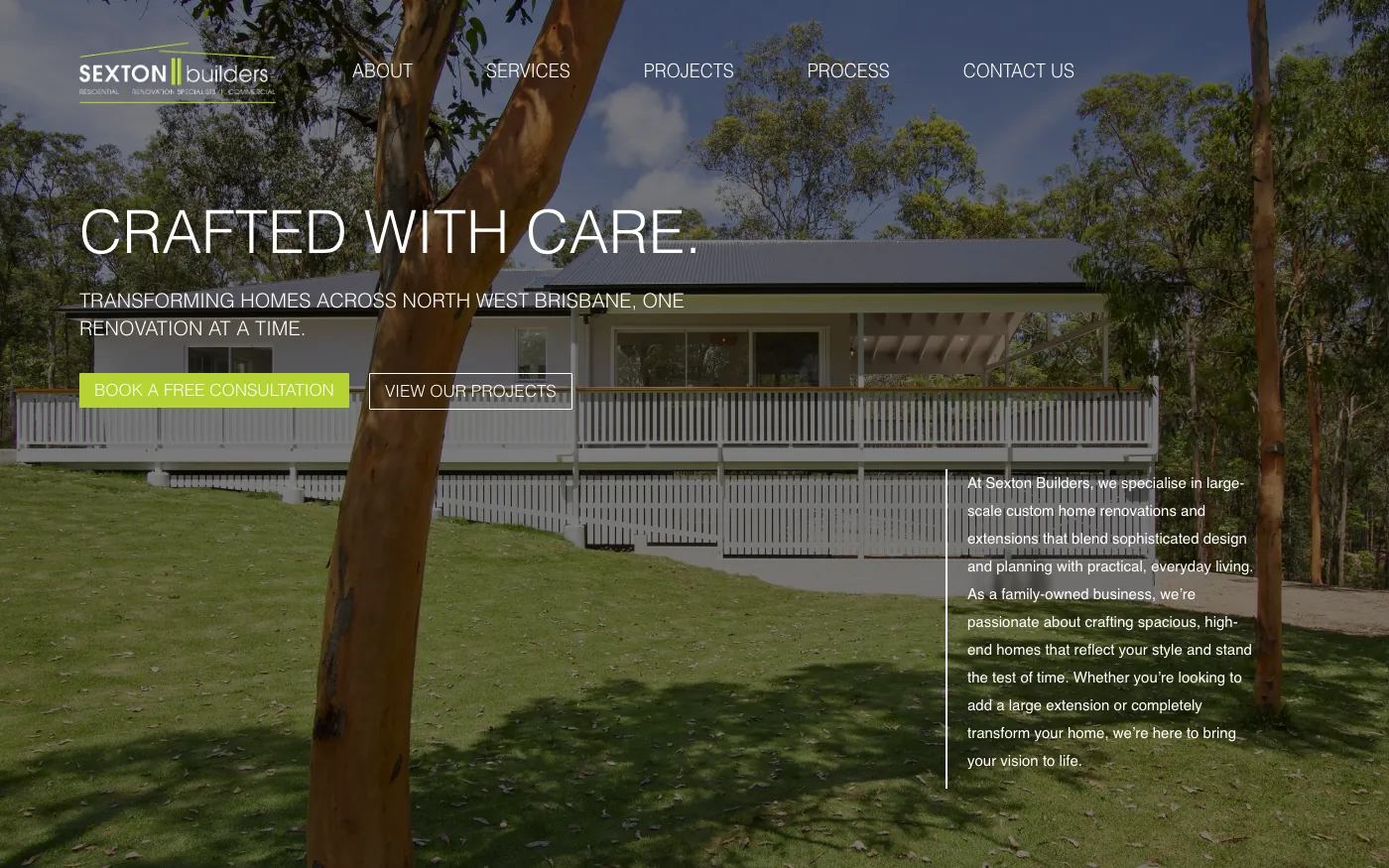
Stock photos of a smiling tradie prove nothing. Your own photos, even from a phone, prove you did the work. Before and after shots work well, and a line under each saying the job and the suburb does more than any claim about quality. The Sexton Builders site above lists its projects by street and suburb, which is the same idea at a bigger scale.
Straight talk on price
If you charge a call-out fee, say so. The ACCC says businesses must display a total price that includes unavoidable fees, and New South Wales says you cannot state a price that is only part of the cost unless the single price is also clearly stated. For work you quote on site, explain how the quote works and what the visit costs. You do not need a price list. You need to stop anyone being surprised.
Reviews people can check
Link to your Google profile rather than typing out quotes nobody can verify. Google says more reviews and positive ratings can help your local ranking, so ask every customer at the same moment, such as when the invoice is paid. Never write them yourself: the ACCC says creating fake or misleading reviews is against the law.
A short quote form that reaches you on the job
Job type, suburb, rough timing and a note. That is enough for the non-urgent work. Send it to your phone and your inbox, then test it yourself, because a form that quietly stopped working costs you jobs you never hear about. If calls go unanswered while you are under a house, an AI receptionist can pick them up and take the details.
Fast on a phone
Someone looking for you in a hurry is often on a phone, on mobile data, standing next to the problem. Google’s Web Vitals guidance says the main content should load within 2.5 seconds. Compressed photos and a simple page get you most of the way. Run your site through PageSpeed Insights for free and see what it says.
Readable by Google and AI assistants
Google says local results depend on relevance, distance and prominence, and that there is no way to pay for a better local ranking. So nobody can promise you a ranking, and you should walk away from anyone who does. What you can do is make the facts easy to read: the same name, number and licence on your site, your Google profile and your directory listings, plus schema markup naming your trade and an llms.txt file for AI assistants.
What you can leave out
- Sliders and popups. They get in the way of the phone number.
- A long company history. A short About page with who runs it, how long, and the licence is enough.
- Claims with no proof. Quality workmanship and competitive prices are what everyone says. A photo and a suburb say more.
- A blog you will not keep up. A page of old posts from three years ago reads worse than none at all.
Websites for plumbers, electricians, builders and cleaners
The list stays the same, but each trade leans on different parts of it.
- Website for plumbers. Emergency calls come first, with job pages for drains, hot water and gas. See websites for plumbers.
- Website for electricians. Contractor licence details on all advertising, and pages for switchboards and the work you want more of. See websites for electricians.
- Website for builders. Bigger decisions, so project galleries and the licence do the selling. See websites for builders.
- Website for cleaners. Trust and how you price matter most, because you are going into people’s homes. See websites for cleaners.
Do you need a website if your work comes from hipages or word of mouth?
You can run a trade business without one, plenty do. But a person given your name by a mate usually looks you up before ringing, and a directory listing belongs to the directory, with your competitors beside you. An enquiry through your own site comes only to you. Keep the directories if they pay. Our hipages review sets out what it costs and how to work out if it is paying.
What a website for tradies costs
Two published guides put a small business site in Australia at roughly $1,500 to $10,000, and our website cost guide sets them out with GST and the ongoing costs. Ours is AU $1,500 + GST in our website sale until 31 December 2026, plus the care plan at AU $100 + GST a month (12-month minimum). That covers six pages with the copy written for you, which for a trade usually means home, services, your main job, service areas, about and licence, and contact.
A ten-minute check of your own site
Open your site on your phone, not your computer, and answer these.
- Can you tap to call without scrolling?
- Is your licence number there, the way your state asks?
- Does it name the suburbs you work in?
- Are the photos yours?
- Does it say how you charge?
- Can someone click through to your Google reviews?
- Send yourself a test enquiry. Did it reach your phone?
- Do your name, number and licence match on your site, your Google profile and your directory listings?
Any no is a job you may be losing to whoever has a yes. Fix them in that order.
Websites for tradies: common questions
Do tradies really need a website?
Not every tradie does, and plenty run on word of mouth. But most people given your name look you up before they ring, and a website is the one place you control what they find. If you want to grow beyond referrals, it is also where your Google profile, ads and directory listings can send people.
How many pages does a tradie website need?
Six is plenty for most trades: home, services, your main job, service areas, about and licence, and contact. Add a page when you have a job you want more of and real photos to show for it.
Does my licence number have to be on my website?
In New South Wales and Queensland, yes: online advertising counts and your licensed name and number have to appear. In Victoria plumbing accreditation belongs to the individual, and electrical contractors put their REC number on promotional materials. Check your own regulator for the final word.
How much does a website for tradies cost?
Two published guides put a small business site in Australia at roughly $1,500 to $10,000. Ours is AU $1,500 + GST in our website sale until 31 December 2026, plus the care plan at AU $100 + GST a month (12-month minimum), with the copy written for you.
Can I just use a Facebook page?
It is a fine extra, and the QBCC counts a company Facebook page as advertising, so your licence details belong there too. But you do not control how it looks or who sees it, and people searching Google for your trade and suburb are better served by a site of your own.
Do I need a page for every suburb?
No. Near-identical suburb pages are the classic mistake, and search engines tend to ignore them. Name the areas you cover, set them on your Google Business Profile, and add a local page only where you have real jobs to show.
Will a new website get me to the top of Google?
Nobody can promise that. Google says local results depend on relevance, distance and prominence, and that you cannot pay for a better local ranking. A good site gives Google clear facts and gives the people who find you a reason to call.
How long does a tradie website take to build?
Ours go live in 10 to 15 business days from the day we have your content: your logo, licence details, the jobs you want and some photos of your work. We write the copy and you review it twice.